
You’re planning a once-in-a-lifetime adventure, and you’ve seen the numbers: a budget Kilimanjaro climb cost can range wildly. The confusion is real. Is $1,500 a steal or a red flag? Does $4,000 include everything? As a local operator, we see the anxiety this causes. This guide cuts through the marketing to show you where your money really goes, what a safe budget actually looks like, and how to plan without nasty surprises.

Seeing a single price is meaningless without knowing what’s behind it. A genuine price breakdown separates ethical operators from cut-rate ones. The biggest fixed cost is the park fee paid to the government. For a standard 7-day climb, this alone is over $1,000 per person.
The rest covers your ground operation: transport from Moshi or Arusha to the gate, all meals on the mountain, tents, cooking equipment, and your crew’s wages. Reputable operators budget a fair wage, insurance, and food for every guide, cook, and porter. If a price seems too good to be true, it’s often because crew welfare is the first thing cut.
Always ask for a written list of inclusions and exclusions. A proper package includes national park fees, camping/hut fees, all meals, drinking water, crew salaries, and airport transfers. What’s usually excluded are flights, visas, tips, personal gear, and travel insurance. Missing any of these core inclusions is a major warning sign.
You’ll see climbs advertised from $1,500 to over $7,000. To make sense of it, think in three tiers. Budget operators ($1,500 – $2,500) often minimize costs on equipment, food quality, and crew support. Mid-range climbs ($2,500 – $4,000) typically offer better safety, newer gear, and fairer crew treatment.
Premium climbs ($4,000+) provide higher guide-to-client ratios, luxury camp amenities, and sometimes shorter route options with private toilets. For a first-time climber focused on safety and success, the mid-range offers the best balance of value and reliability.
A price under $2,000 for a 7+ day climb is a serious concern. To hit that number, operators drastically reduce costs somewhere. This often means overloaded porters, older or shared gear, minimal food, and guides with less training. Your safety and summit chances are directly tied to the crew’s well-being and experience.

The route you choose is one of the biggest cost drivers. It dictates the number of days in the park (daily fees add up) and the logistics complexity. The Marangu route is often marketed as the cheapest because it uses huts instead of tents, but its shorter 5-day itinerary has a much lower success rate, making it a false economy for many.
The popular 6-day Machame route and 7-day Lemosho route offer better acclimatization profiles. Their costs are similar, though Lemosho is slightly more due to longer transport and an extra park day. The longer 8-day Northern Circuit or 9-day Lemosho variations cost more but give you the highest chance of reaching the summit safely.
Each extra day on the mountain adds park fees, food, and wages. An 8-day climb will logically cost more than a 6-day one. However, this investment dramatically increases your acclimatization, comfort, and likelihood of success. View it as paying for a higher probability of standing on the roof of Africa.

The package price is just the start. To avoid shock, you must budget for these unavoidable extras. International flights to Kilimanjaro Airport (JRO) vary by season and origin, but are a major cost. A Tanzanian tourist visa costs $50 for most nationals and is obtained on arrival.
Travel insurance with specific high-altitude medical evacuation coverage is non-negotiable. Personal gear (rental or purchase) is another cost. Finally, tipping your crew is a customary and vital part of the climb culture. Budget a minimum of $250-$350 per person for the entire crew, in cash.
You’ll need at least one hotel night before and after the climb. This is rarely included in the cheapest packages. You’ll also want money for meals in town, souvenirs, and any unexpected costs. A good rule is to add 25-30% to your climb package price to cover all these ancillary expenses.
Tell us what you have in mind and we’ll build you a free, no-pressure itinerary with honest pricing — planned by a local team that runs these trips every day.
Let’s define a “budget” climb not as the absolute cheapest, but as the minimum for a safe, ethical experience with a realistic shot at the summit. Based on current park fees and fair operating costs, that realistic starting point for a 7-day climb is around $2,300 to $2,800.
At this level, you should expect good quality communal equipment (tents, mess tent), three solid meals a day, treated drinking water, and a crew paid fair wages. You’ll share a tent with another climber and might have larger group sizes. The focus is on the essential experience: a well-supported climb up the mountain.
To hit this price point, operators use standard menus, well-maintained but not brand-new gear, and efficient logistics. They don’t offer extras like private toilets, larger dining tents, or single supplements without an added fee. The guiding is professional, but the client-to-guide ratio might be at the higher end of the safe range.
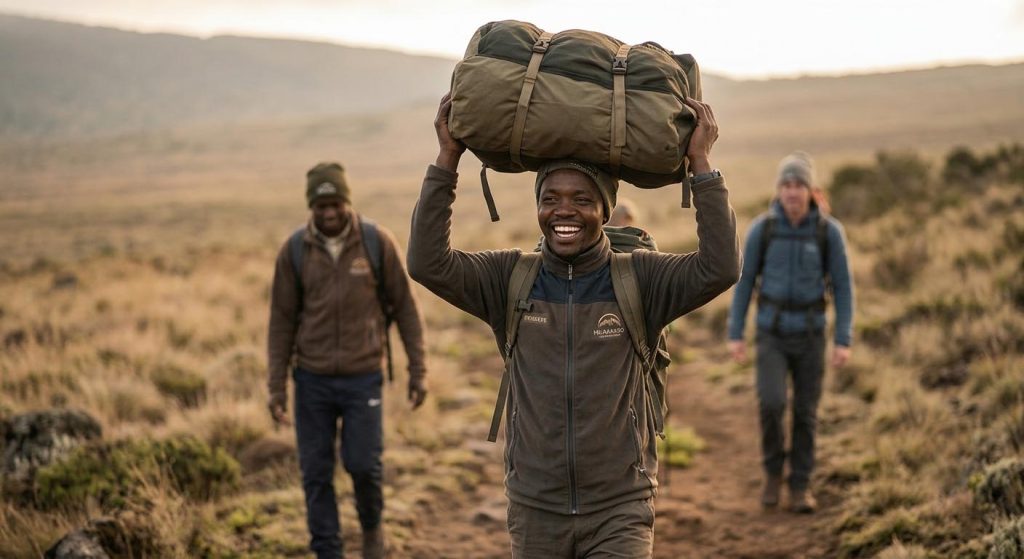
Value isn’t just about price; it’s what you get for your money. Budget operators deliver the core service. Mid-range operators often provide better food variety, newer tents, more experienced head guides, and sometimes a lower climber-to-guide ratio for more personalized attention.
Premium operators offer luxury touches: spacious dome tents, comfortable camp chairs, gourmet meals, and sometimes oxygen systems for backup. They invest heavily in guide training and have extensive safety protocols. Your choice depends on how much comfort and personal attention you need during a physically demanding week.
To compare value, ask any operator: What is your climber-to-guide ratio? What is the menu like? Can I see photos of the actual tents and equipment? How are porters’ loads monitored? The answers will tell you more about real value than any brochure.
A huge portion of your climb fee never touches the operator’s pocket—it goes directly to the Tanzania National Parks Authority (TANAPA). These are fixed, non-negotiable costs that every operator pays. They include conservation fees, camping/hut fees, and rescue fees.
For a 7-day Machame climb, these government fees alone currently total over $1,100 per person. This is why prices below a certain point are unsustainable without cutting corners elsewhere. A transparent operator will happily explain this breakdown, showing you how much is for the park and how much is for their services.
Park fees are reviewed and often increased by the government periodically to fund conservation and community projects. This is a positive thing for the mountain’s future, but it means climb prices inevitably creep up over time. An operator quoting a price significantly lower than the competition may be using outdated fee calculations.
Kilimanjaro has two main trekking seasons: the dry seasons. The long dry season (June-October) is the busiest and most expensive. The short dry season (January-March) is also popular but can be slightly less crowded. Prices are generally at their peak during June-September.
The rainy seasons (April-May and November) are less popular. Some operators offer discounts during these periods, but be prepared for wet, muddy, and colder conditions. The trails are quieter, but the weather adds a significant challenge and can obscure the famous views.
A discounted rainy-season climb saves money but increases physical difficulty. Trails are slippery, cloud cover is common, and you’ll need higher-quality waterproof gear. If your primary goal is the summit and a comfortable experience, the premium for the dry season is usually worth it.

Tipping is not optional; it’s a critical part of the crew’s income. The industry standard suggests budgeting $20-$25 per day for the guide, $15-$20 per day for the assistant guide, $10-$15 per day for the cook, and $8-$10 per day for each porter.
For a typical 7-day climb with a crew of 10-12 people, this totals $250-$350 per climber. This money is pooled and distributed at a tipping ceremony on the last day. Bring this amount in clean, newer US dollar bills. Your head guide can help facilitate the fair distribution.
This team carries your gear, sets up your camp, cooks your meals, monitors your health, and motivates you every step. The tip is a direct thank-you for their hard work. Factoring it into your total climb cost from the beginning prevents last-minute stress.
Before you book, run your numbers against this list. First, the climb package itself (aim for $2,300-$4,000 for 7 days). Second, international flights (varies widely). Third, Tanzania visa ($50). Fourth, gear rental or purchase (budget $200-$500 if buying new).
Fifth, travel insurance with high-altitude cover ($100-$200). Sixth, tips ($250-$350). Seventh, hotel nights and meals not included (2-3 nights, ~$50/night). Eighth, miscellaneous spending money. Adding this up gives you the true total cost of your Kilimanjaro adventure.
Once you have a realistic budget, book with an operator that has clear terms, good reviews, and responsive communication. Ensure your deposit is protected and you understand the cancellation policy. This climb is a major investment of money and spirit—doing your homework upfront ensures it’s one you’ll cherish.